Innovators
K12.1Visionaries on the frontline of creating new industry sectors and new opportunities.
Foresight from the companies building the future.
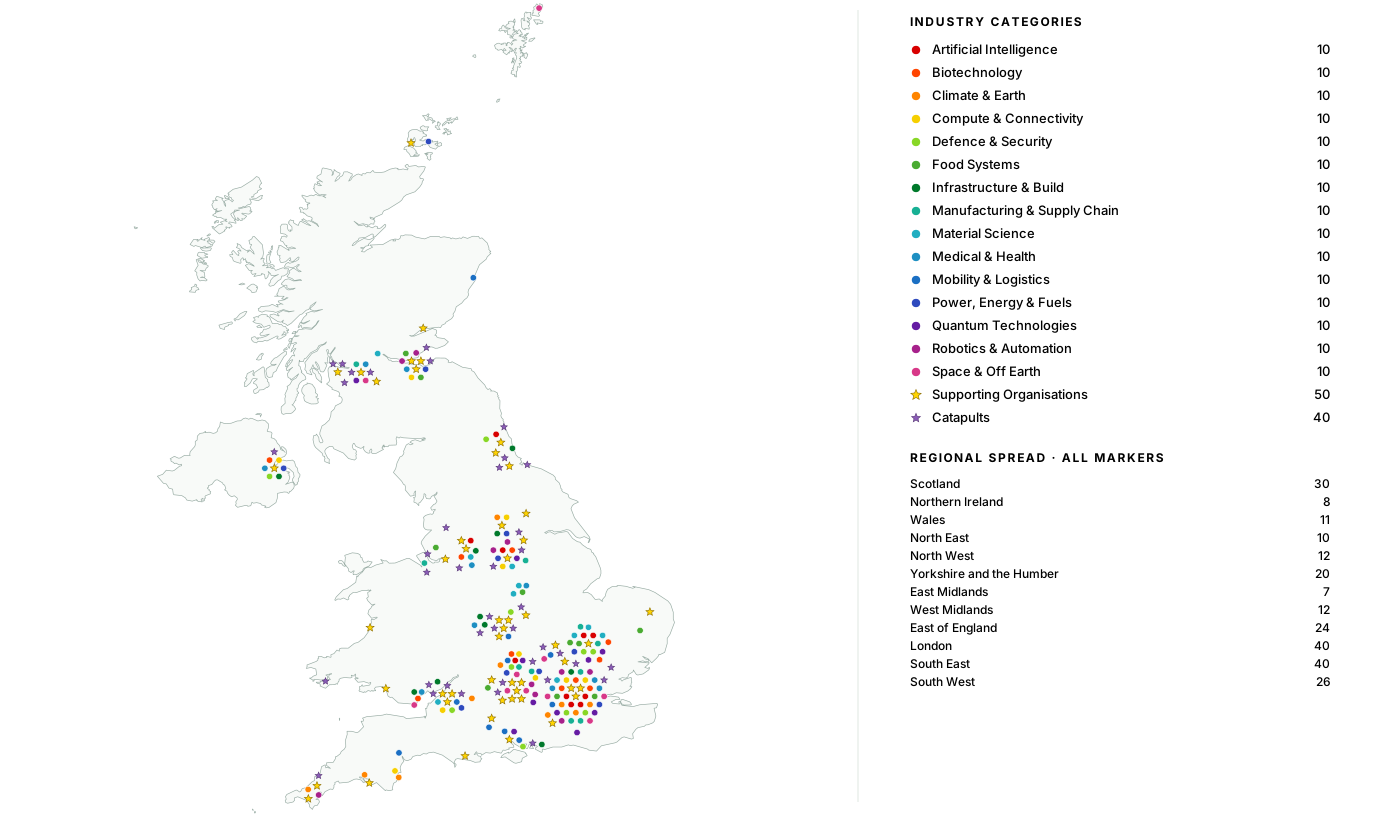
K05.1The UK is home to an exceptional innovation ecosystem; a national asset which will play a critical role in building a stronger and more competitive future economy.
K05.2From startups and scaleups to SMEs and major UK-headquartered organisations, companies across this landscape are not only creating new products and solutions, pioneering scientific breakthroughs and raising industrial capabilities, they are creating new forms of work, new types of jobs and new employment opportunities for the future.
K05.3This makes the innovation economy a vital landscape to study to understand where these opportunities will be nurtured, what they will look like, and what the UK must do to prepare for this future.
K06.1Leaders across the UK’s innovation ecosystem are operating at the forefront of change, building new industries and developing solutions to our era's biggest challenges. As such, their viewpoints are vital to understanding future workforce dynamics, challenges and opportunities.
K06.2Their insight can highlight what traditional labour market data often cannot capture: which job types are starting to emerge, which skills will be in demand, and what kinds of support innovation-led companies need in order to build strong teams as they scale.
K06.3The report will listen directly to these leaders, not only to identify future jobs and skills, but to represent the practical requirements of innovation companies as employers.
K04.1Reindustrialisation strategy, sovereign resilience, regional growth, apprenticeships and talent shortages are all discussion points high on the agenda.
K04.2The UK government's Industrial Strategy is focused on future growth sectors, with the DCMS Digital and Technologies Jobs Plan stating that over the next decade around 800,000 roles will need filling across these sectors alone. The Skills England annual skills report 2026 is also focused on skills demand for priority sectors, while the Milburn Review and the King’s Trust record fast-increasing levels of young people not in education, employment or training (NEETs).
K04.3This UKII report lands at a moment when government, industry and educators need live employer insight to turn ambition into workforce readiness. The output will provide timely, on-the-ground foresight – from the companies building new sectors and creating new opportunities – and highlight the support system required to scale UK jobs growth.
K03.1Through a substantial 6-month process, the UKII task force will build an online resource making visible future jobs and skills requirements across the innovation industries.
K03.2The report will examine the emerging types of work – the roles, capabilities and skills that will be in demand – across the industries at the forefront of shaping the future economy.
K03.3The process will draw on detailed interviews with leaders across future-facing industry sectors, alongside a wider survey of the innovation ecosystem.
The research will also capture the impact on future workforce of integrating innovation-led products and services for wider industry and customer audiences.
The output will help policymakers, educators and the ecosystem visualise the talent pipeline required for these companies to scale, employ strongly, and contribute to economic growth.
K07.2There is huge debate around how the major forces of AI will radically reshape business and the dynamics of work. However there is little visibility of what an AI-collaborative workforce will look like, what skills and roles will be most needed across UK industry, and where the opportunities are to build strong employment pathways and robust, future-proofed industry.
K07.3This report will capture the viewpoints of the people at the forefront of building and deploying AI solutions, and integrating intelligent systems across business and industry settings – translating uncertainty into positive, practical foresight of the impact of AI on future workforce.
K08.1Today's young talent are making education and career decisions without good visibility of the opportunities being created across emerging areas of industry.
K08.2Future jobs do not have familiar titles, pathways or visible role models;
K08.3Educators and careers advisers need live insight from within the innovation ecosystem;
K08.4Regional clusters risk missing opportunities to connect young talent with industry.
K08.5The report will help make visible the pathways required for the next generation of talent, from education through to the jobs of the future.
K12.1Visionaries on the frontline of creating new industry sectors and new opportunities.
K12.2Company builders with first-hand hiring and growth experience.
K12.4The people closest to emerging capabilities and innovation delivery requirements.
K12.5Insight on clusters, place-based strengths, and regional opportunities and constraints.
K12.6Context from education, skills and training organisations.
K12.7A wider view of company growth, talent gaps and market signals.
K12.8Viewpoints on integrating innovation-led solutions within customer organisations.
K12.9Government voices connecting company insight to industrial strategy priorities.
K16.1Investigating how and where pioneering companies are forging new types of work.
K16.2Highlighting emerging roles, and the types of work most likely to increase in demand.
K16.3Defining the technical, operational and human capabilities leaders expect to need the most.
K16.4Outlining the forces reshaping work and the gaps in visibility between stakeholders.
K16.5Mapping patterns across industries, regions and clusters: strengths and challenges.
K16.6Articulating stakeholder actions to support a dynamic future talent pipeline.
K20.1UKII is seeking a total of £145,000 + VAT to deliver the findings of this 6-month research project as an interactive online resource, and transform the intel into event contributions around launch in March and April 2027. We would ideally like to work with one Headline Sponsor.
K20.3This funding calculation includes:
K20.4Research team£75,000 + VAT
K20.5Design and development of platform£30,000 + VAT
K20.6Administrative & comms£20,000 + VAT
K20.7Launch event overheads£20,000 + VAT
K20.8If no single Headline Sponsor, suggested alternative split of sponsorship profile:
K20.9Lead Partner (1)£75,000 + VAT
K20.10Top level visibility positioning with thought leadership input across the report, and the resulting comms and activity.
K20.11Ecosystem Partner (1)£40,000 + VAT
K20.12Sector and regional sponsor options, to collaborate on highlighting specific areas of industry and opportunity.
K20.13Platform Partner (1)£30,000 + VAT
K20.14Tech-sector sponsor option to support the development of the online platform and resource.